WHEN IS THE LAST TIEM YOU’VE BEEN …. FLOCKED … OR DID YOU EVEN NOTICE?

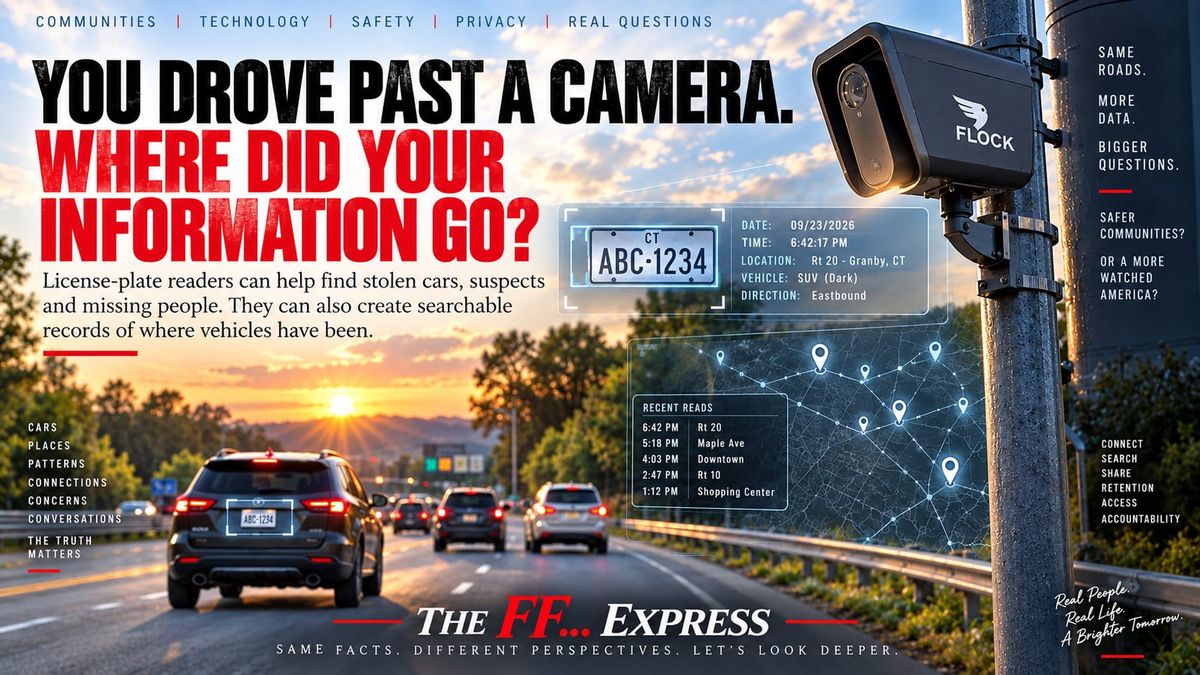
License-plate readers can help find stolen cars, suspects and missing people. They can also create searchable records of where vehicles have been. As communities across America reconsider automated license-plate readers, the real question isn’t whether the cameras work. It’s what happens to the information after they do.
Flock cameras have helped police recover abducted children, identify suspects and find stolen vehicles. They have also been misused to track innocent people, contributed to investigations that went terribly wrong, and created a searchable record of vehicles moving through American communities. The technology works. That may be exactly why we need to understand how much power we have handed it.
You drove to work. Maybe you are went to the grocery store, or took your dog to the vet. Maybe you went to see your mom, or stopped for a coffee or drove to dinner with some friends. Maybe you went to church, a gun range, a political meeting, your lawyers office, your house, or somebody else’s house—or maybe you drove nowhere remotely interesting at all.
One camera remembered, then another, then, another camera remembered.
You haven’t been pulled over. You haven’t been accused of anything. You may not even notice the camera. And that is part of the point. You aren’t necessarily supposed to notice it. It is supposed to notice you.
An automated license-plate reader can capture your plate, photograph your vehicle, record the date, time and location, and identify characteristics of the vehicle passing in front of it. Flock Safety’s cameras are now part of a network the company says includes more than 120,000 cameras across 49 states. Sen. Josh Hawley, citing Flock’s own figures as he opened a congressional investigation into the company, said the system produces more than 20 billion vehicle scans every month.
Twenty billion. Most of those vehicles are not fleeing bank robberies. They aren’t carrying kidnapped children. Their drivers aren’t wanted for murder. They are us. That doesn’t make the technology useless. Far from it. But it does make the question much larger than whether a camera can read a license plate. Who gave a private company this much power to build a nationwide vehicle-surveillance infrastructure, who controls what happens inside it, and what protections existed before tens of billions of records started moving through it?
THIS ISN’T JUST A TRAFFIC CAMERA
Flock cameras are automated license-plate readers, commonly called ALPRs. The technology doesn’t merely take a pretty little picture of a license plate and forget about it.
Flock says its customers own the data their systems collect. Those customers can include law-enforcement agencies, businesses, schools and community organizations. According to Flock, customers decide who within their organizations can access their information, whether that information is shared, and how long it is retained within applicable rules. Flock says it does not sell customer data for advertising and that searches are logged for auditing.
But the cameras can capture considerably more than six or seven characters stamped onto a piece of metal.
Vehicle characteristics can make observations searchable. Civil-liberties advocates appearing before Congress have described systems capable of cataloging attributes such as make, model, color, bumper stickers, roof racks and visible damage. The ACLU describes Flock’s technology as using artificial intelligence to catalog vehicle features including scratches. So yes, your ridiculous bumper sticker may matter. So may the dent in the door, the roof rack and the color of your SUV. One observation tells somebody where a vehicle was once.
Thousands of cameras create something different. A camera sees your vehicle Monday morning. Another sees it Tuesday afternoon. Another records it Wednesday evening. Connect enough observations and a collection of isolated photographs can begin looking remarkably like a history of movement. That is where the license-plate reader becomes something much more powerful than the old traffic camera sitting above an intersection.
AND THEN THERE IS LINDSEY ISAACS
This is where the theoretical conversation ends. Lindsey Isaacs owned a black Dodge Durango. In October 2025, a terrible crash on Interstate 4 in Florida killed three people. Witness evidence pointed toward a maroon Dodge Durango. A Flock camera had captured Isaacs’ black Durango a few miles from the crash around the relevant time.
Investigators focused on her.
But other evidence didn’t fit. Her vehicle didn’t have collision damage consistent with causing the crash. There was evidence pointing toward a differently colored Durango. Isaacs also maintained that she hadn’t caused the accident. She faced eight felony charges and spent 13 days in jail, including days in solitary confinement, before prosecutors declined to prosecute her. Authorities subsequently arrested another woman in connection with the crash. Those charges remain allegations unless proved in court.
And here is an important distinction. The camera appears to have actually photographed Isaacs’ vehicle. The catastrophic failure came in what human beings concluded from that information and how they weighed it against conflicting evidence. That may be more troubling than a machine simply reading a plate incorrectly. Technology can produce information that looks incredibly precise: this vehicle, this location, this time. Precision can create authority. Authority can create certainty. And certainty can be spectacularly fucking dangerous when it is wrong—or when the conclusions built upon it are wrong.
Isaacs appeared before the United States Senate today, September 23, at a Judiciary subcommittee hearing with an unusually blunt title: “Always Watching: Flock’s Nationwide AI Surveillance Network.” Congress is now asking some of the same questions ordinary Americans should probably have been asking before the network became this large.
BUT THEN A 13-YEAR-OLD GIRL GOES MISSING
Now comes the part that makes this story considerably harder. In July, authorities in Marion County, Florida, were searching for an abducted 13-year-old girl. An AMBER Alert went statewide.
Sheriff Billy Woods said license-plate readers helped investigators identify and track the suspect vehicle. An alert citizen who saw the AMBER Alert also recognized the vehicle and called 911. Deputies eventually located it, and the girl was rescued and returned safely to her family.
Then there is Bakersfield, California. Earlier this month, an 11-year-old girl was allegedly kidnapped. Police say information obtained during the investigation, combined with Flock cameras, helped them identify the suspect vehicle. A 29-year-old man was later arrested on suspicion of kidnapping, rape of a child under 14 and child molestation. Those remain allegations unless proved in court.
That matters. We cannot scream about Lindsey Isaacs and quietly hide the little girl who got home. Same technology. Very different outcome. And that is precisely why this conversation deserves something better than slogans.
NOW LET’S TALK ABOUT POWER
Flock Safety is not the FBI. It is not Congress. It is not a state government. It is a private company. That distinction becomes extraordinary when you consider the scale of the infrastructure it has created.
Government agencies buy or use the technology. Private organizations can buy cameras too. Flock builds the hardware and software platform that makes those observations useful and searchable. Flock says its customers—not Flock itself—own and control their data, determine access and sharing, and control retention within applicable rules.
That may answer the narrow question of who owns an individual customer’s records. It does not answer the larger democratic question. How did America arrive at a place where a private company’s technology could become part of a nationwide surveillance infrastructure before the country settled the rules governing nationwide surveillance?
There was no national referendum in which Americans voted, Yes, please construct a searchable system capable of documenting vehicle movements throughout the country. Instead, the network grew camera by camera, police department by police department, city contract by city contract and private customer by private customer.
That is not necessarily illegal. But legal authority, technological capability and democratic consent are not the same fucking thing. And once the infrastructure exists, regulation is no longer deciding whether such a system should be built. It is deciding what to do with the system we already have.
WHAT HAPPENS WHEN SOMEONE ABUSES IT?
We do not have to invent this scenario either. A Florida police officer was accused this summer of searching his estranged wife’s license plate in the Flock database 717 times between September 2024 and June 2026. According to the probable-cause allegations, she was not involved in a criminal investigation, while search justifications included categories such as wanted person and drugs/narcotics. The officer was charged; the allegations must still be adjudicated.
And that case is not standing alone. A Washington Post investigation found at least 69 police officials who had been accused, charged or convicted of misusing Flock or other license-plate-reader systems. The Post also found departments that were not routinely auditing their own officers’ searches. In one Indianapolis case uncovered by the newspaper, an officer appeared to have conducted 3,759 searches involving vehicles used by his wife and two personal acquaintances. The department began investigations after reporters brought the activity to its attention.
Read that again. The system had audit logs. The existence of a log did not necessarily mean someone was routinely looking at it. That distinction matters enormously. A surveillance system can record who searches it. Somebody still has to police the police who use it.
WHAT ABOUT A WARRANT?
This may eventually become one of the biggest questions surrounding the technology. A police officer physically attaching a GPS tracker to someone’s vehicle raises obvious Fourth Amendment issues. But what happens when police don’t need to attach anything because thousands of cameras have already recorded where the vehicle appeared?
At today’s Senate hearing, witnesses argued for stronger federal limits, including warrant requirements for searches of historical ALPR databases. The constitutional question is contested, and courts are still confronting how traditional Fourth Amendment rules apply to increasingly comprehensive networks of observations made on public roads.
That is not a minor legal technicality. “Did this stolen car pass here?”
and “Show me everywhere this person’s car has appeared.” may involve the same database. They are not necessarily the same kind of government search. Technology has made that distinction incredibly easy to blur.
CONGRESS HAS FINALLY NOTICED
The backlash has become bipartisan. Republican Rep. Thomas Massie of Kentucky and Republican Rep. Eric Burlison of Missouri introduced the Flock-Off Act this month. The bill would prohibit federal money from being used to purchase, install, maintain, operate or upgrade covered automated license-plate readers and biometric-surveillance cameras. It is a proposal, not law.
Meanwhile, today’s Senate hearing examined privacy, constitutional protections and alleged misuse of Flock’s network. Civil-liberties advocates, cybersecurity experts, law-enforcement representatives and Lindsey Isaacs testified.
This is no longer a fringe argument about whether cameras are creepy. The United States Congress is examining the architecture itself. And perhaps it should. Because once technology becomes powerful enough, “trust us” is not oversight.
A company policy is not legislation. An audit log is not an audit. And the fact that information can help solve a crime does not automatically answer whether every innocent person’s information should be collected in order to make that possible.
SO WHERE THE FUCK IS THE LINE?
We aren’t going to manufacture a neat answer because there isn’t one. Tell the parents of an abducted child that police should not use the camera that may locate the vehicle carrying her. Now tell Lindsey Isaacs that highly precise technological evidence cannot create dangerous tunnel vision because the system has safeguards. Tell a community that license-plate readers recovered its stolen cars. Then tell an innocent woman that an officer allegedly searched her location 717 times.
Every one of those things belongs in the same conversation. The question isn’t whether Flock cameras can do good. They ... can. The question isn’t whether they can contribute to terrible outcomes or be abused. They can.
The question is whether the legal safeguards, warrant requirements, access restrictions, auditing, retention limits, data-sharing rules and public accountability surrounding this enormous system are remotely keeping pace with what the technology can already do.
And underneath all of that sits the question we aren’t finished investigating: Why does a private company have this much power in the first place? Who pays for the cameras? Who profits from them? Which private organizations operate them? Which government agencies can search information originating elsewhere? How far can one search travel? Who approves access? When is a warrant required? Who notices when an employee abuses the system? What happens when the information is wrong? And how does an innocent person meaningfully challenge a technological record that arrives in court looking like objective truth?
Those aren’t paranoid questions. They’re governance questions. And this story isn’t finished. Not even fucking close. For now, the next time you notice one of those little cameras overlooking the road, look back. Because while you may never have noticed it before, it has certainly noticed you. Then ask the question that should have been asked before 120,000 cameras and 20 billion monthly scans became normal:
Who is watching the watchers?
THE RECEIPTS
FFE: Today’s U.S. Senate Judiciary hearing provides the starting point for this investigation, including testimony concerning wrongful identification, law-enforcement use, privacy, cybersecurity and constitutional protections. The Isaacs case has also been independently reported, including the evidence that conflicted with the original theory of the crash. Judiciary Hearings
FFE: Flock’s own material states that customers own the data collected through their systems and control access, sharing and retention. That is Flock’s account of its system and should be read alongside independent investigations into actual use and misuse. Customers Own and Control Their Flock Data
FFE: The Marion County and Bakersfield cases document the other side of the technology: circumstances in which law enforcement says ALPR information contributed to locating an abducted child or identifying a vehicle in a child-kidnapping investigation. Marion County AMBER Alert
FFE: The Flock-Off Act provides the current federal legislative proposal to restrict federal funding of these systems. Thomas Massi "Flock-Off Act"
DON’T TAKE OUR FUCKING WORD FOR IT. READ THE RECEIPTS.
Same facts. Different perspectives. Let’s look deeper.