THE BOND MARKET

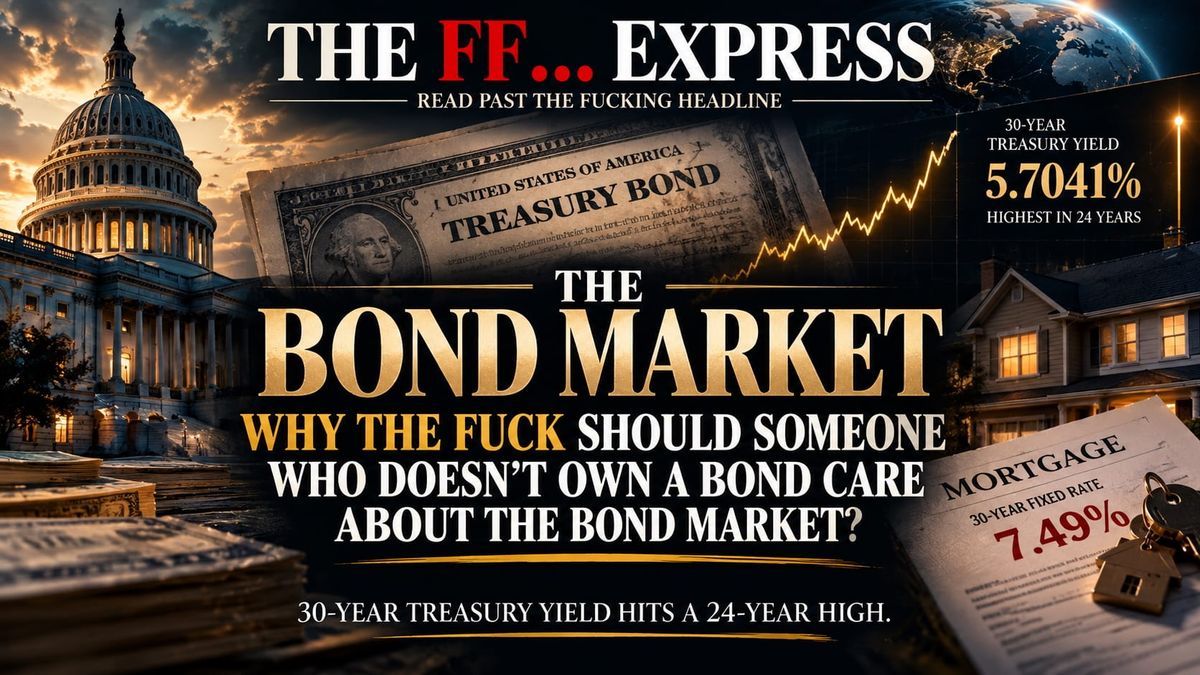
WHY THE FUCK SHOULD SOMEONE WHO DOESN’T OWN A BOND CARE ABOUT THE BOND MARKET?
You don’t own a bond. You’ve never bought a bond. You may not know what a Treasury yield is, and until approximately thirty seconds ago, you probably had no fucking intention of finding out. Fair enough. Unfortunately, the bond market knows where you live. It knows where you bought your house. It affects what somebody else may be willing to pay for that house. It reaches into the interest rate on the next mortgage, the cost of borrowing money to open a business, the value of investments sitting inside retirement accounts, and the amount of money the United States government must spend simply paying interest on money it already borrowed. You can spend your entire life never deliberately purchasing a Treasury bond and still have the bond market wandering through your financial life like it fucking owns the place.
And right now, something important is happening there. On Wednesday, October 7, U.S. Treasury yields pushed to levels not seen in roughly 24 years before backing away from their highs later in the day. The Treasury Department’s official daily curve finished Wednesday with the 10-year Treasury yield at 5.28% and the 30-year at 5.67%. On Monday, those official closing yields had been 5.31% and 5.66%, respectively. Reuters reported that Wednesday’s intraday move carried both maturities to fresh 24-year highs before a strong $39 billion auction of 10-year Treasury notes and falling oil prices helped calm the selloff.
Those numbers look spectacularly boring. They aren’t.
FIRST, WHAT THE FUCK IS A BOND?
Strip away Wall Street’s vocabulary and a bond is basically an IOU. Imagine that I need $100. You lend it to me. In exchange, I promise to pay you interest and eventually return your $100. Congratulations. We have just created a tiny fucking bond.
The United States government does essentially the same thing on an enormous scale. The government spends money every day, and when it spends more than it collects, it must borrow the difference. The Treasury does that by selling securities—Treasury bills, notes and bonds—to investors. Those investors include ordinary people, banks, pension funds, mutual funds, insurance companies, corporations, foreign institutions and governments. They give the United States money now. The United States promises to pay according to the terms of that security.
Now we need exactly one piece of Wall Street vocabulary: yield. For what we’re doing here, think of yield as the return investors receive for owning that debt. There are technical differences between a bond’s coupon, price and yield, but you don’t need a fucking finance textbook to understand the mechanism. If investors are willing to pay more for an existing bond, its yield falls. If they demand a cheaper price before buying it, its yield rises. Bond prices and yields generally move in opposite directions. That single relationship explains an astonishing amount of financial news.
Why would investors suddenly demand a higher yield? Put yourself in their chair. Somebody asks you to lend them money for ten, twenty or thirty years. You start asking questions. What will inflation do to the purchasing power of the dollars you eventually get back? Could you earn more somewhere else? How much debt will this borrower issue in the future? What will interest rates look like next year? What could happen economically between now and the day you finally get your money back?
If those risks look bigger, you want to be paid more.
Congratulations. You understand the fucking bond market.
NOW WHY THE FUCK SHOULD YOU CARE?
Because U.S. Treasury securities help establish the baseline price of money throughout the American financial system. They are not the only thing determining mortgage rates, business loans, credit markets or stock valuations, but they are woven through all of them. The yield available on relatively low-credit-risk U.S. government debt becomes a reference point investors use when deciding how much return they require before accepting additional risk elsewhere.
Suppose you have money to lend. The United States government is offering you a healthy return. Then somebody else comes along and asks you to finance a business, a corporation or a pool of mortgages. You’re taking additional risk. You’re probably going to demand additional return. That is why a move in Treasury yields can eventually show up far away from Treasury securities themselves. And right now, you can see that mechanism landing squarely on the American housing market.
The Mortgage Bankers Association reported Wednesday that the average contract rate for a conforming 30-year fixed mortgage jumped from 7.30% to 7.49% during the week ending October 2, the highest level in almost three years. Mortgage applications fell 4.2% from the previous week. Purchase applications fell 2%, while refinancing applications dropped 8% and were 56% below the same week a year earlier. MBA specifically attributed the rate increase to rising Treasury rates combined with wider mortgage-market spreads and greater rate volatility.
There it is. You don’t own a bond.
Your mortgage doesn’t give a fuck.
LET’S TURN 7.49% INTO ENGLISH
Percentages have a nasty habit of looking harmless until somebody attaches dollars to them. So let’s attach some fucking dollars.
Imagine a $400,000, 30-year fixed-rate mortgage, ignoring property taxes, homeowners insurance and other costs so we can isolate what the interest rate itself does. At 5%, principal and interest would be about $2,147 per month. At 7.49%, that payment is about $2,793 per month. Same $400,000. Same 30 years.Roughly $646 more every fucking month. The house did not grow another bedroom. Nobody installed a pool. The kitchen did not suddenly acquire Italian marble countertops and a personal chef named Giuseppe. The money got more expensive.
Over a year, that difference is roughly $7,750. Over many years, assuming the mortgage remains outstanding, the cumulative difference becomes enormous. That is why mortgage rates can change the housing market even when home prices themselves barely move. Buyers don’t purchase a house using only the sticker price. Most buyers purchase a monthly payment, and interest determines a very large part of that payment. At some point the payment becomes too expensive. A buyer lowers the price range, delays buying altogether or stays where they are. Enough people make that decision and housing activity slows. That is the bond market reaching somebody who has never purchased a fucking bond.
AND THE HOUSE ITSELF DOESN'T STAND STILL EITHER
Suppose a builder tells you in 2022 that a house will cost $500,000 to build. Two years later, you ask for essentially the same house and nearly fall over when the number comes back at $600,000. Your first reaction may be: What the fuck? It's the same house.
It may be the same house on paper. It is not the same economic transaction. The builder has to buy lumber, concrete, roofing, windows, electrical equipment, plumbing, appliances and everything else that goes into the house at today's prices, not the prices from your last build. The electricians, plumbers, framers, excavators and other trades have today's labor costs. Insurance, fuel, permits, equipment and transportation cost what they cost today. And if the builder or developer is borrowing money to buy the land, carry the property, finance construction or operate the business while your house is being built, the price of that money has changed too.
Now imagine construction takes a year. Every month that borrowed money remains outstanding costs something. If financing becomes substantially more expensive, the builder cannot simply say, Well, Cristina's last house was cheaper, so we'll pretend interest rates, wages and material prices haven't fucking moved. Those costs have to go somewhere. They get absorbed by the builder, squeezed out of the project, negotiated away somewhere else—or eventually appear in the price of the house.
And here's the part people sometimes miss: a more expensive house combined with a more expensive mortgage hits the buyer twice. The house itself may cost more to produce, while the money required to buy it also costs more to borrow. That's how somebody can build a larger house several years ago for less than a smaller house costs today without anybody necessarily playing some elaborate fucking shell game. That doesn't mean every builder's price increase is justified. It means yesterday's construction price is not evidence of today's construction cost.
THE BUSINESS DOWN THE STREET GETS HIT TOO
Now leave the house and walk down the street to a restaurant, manufacturer, construction company or little business trying to expand. Businesses routinely borrow money to buy equipment, build facilities, finance inventories, develop products and expand operations. Larger companies can issue bonds directly. Smaller businesses may borrow from banks or other lenders whose own funding costs are influenced by broader interest rates. Every business investment has to clear a basic hurdle: Will this project make enough money to justify what it costs?
Imagine a company considering a new facility. At a relatively low borrowing cost, the numbers work. The company borrows the money, builds the facility, buys equipment and hires people. Raise the financing cost substantially and the exact same project may stop making financial sense. Nothing happened to the building. Nothing happened to the equipment. Nothing happened to the workers. The price of the money changed.
One company postponing one expansion doesn’t alter the national economy. Thousands of companies simultaneously becoming more cautious about borrowing can. Investment slows. Construction gets postponed. Hiring plans change. Riskier projects get killed first. Suddenly our supposedly boring bond market has walked straight into the fucking break room.
THEN WE GET TO THE BIGGEST BORROWER IN THE ROOM
The United States government. This is where the story stops being merely about mortgage rates and starts becoming about the federal budget itself.
The Congressional Budget Office projects that the federal government will run a $1.9 trillion deficit in fiscal 2026. Debt held by the public is projected at roughly 101% of GDP this year. CBO estimates that the government’s net interest cost will reach about $1.0 trillion in 2026, up roughly $69 billion from 2025. Under its current baseline, net interest costs climb to $2.1 trillion by 2036.
Read that again. Approximately one trillion dollars in net federal interest expense this year. That is not money paying teachers, paving highways, buying fighter jets, funding Social Security benefits or curing cancer. It is the cost associated with financing federal debt.
There is an important mechanism here that people often miss. If the 30-year Treasury yield jumps today, the entire federal debt does not instantly begin costing 5.67%. Treasury securities were issued at different times with different interest rates and different maturity dates. But debt constantly matures. The government also continues borrowing new money. When older, cheaper debt matures and has to be replaced in a higher-rate environment, or when new deficits require new borrowing, today’s higher rates gradually work their way into tomorrow’s federal interest bill.
CBO estimates the average interest rate on federal debt held by the public at about 3.4% in 2026. If borrowing costs remain elevated as securities mature and are refinanced, that average can rise over time. And because the government is already running large deficits, rising interest costs can create a particularly unpleasant loop: borrow money → pay more interest → larger financing requirement → borrow more money.
That does not mean the United States is suddenly unable to borrow. Wednesday actually supplied evidence in the opposite direction: Treasury’s $39 billion 10-year auction attracted strong demand, helping pull yields back from their intraday highs. But that auction answers only one day’s version of a question that keeps returning: How much does America have to pay people to lend it money? That question matters a hell of a lot more than most people realize.
SO WHY ARE YIELDS SO FUCKING HIGH?
There isn’t one culprit standing behind a curtain with a giant red RAISE BOND YIELDS button. There are several forces hitting at once.
Inflation is one. Investors who lend money for decades care deeply about inflation because they’re being promised dollars in the future, and inflation determines how much those future dollars can actually buy. If you lend somebody $100 and eventually receive $100 plus interest, you care whether groceries cost twice as much when you get it back.
That concern has intensified again. The New York Federal Reserve reported Wednesday that consumers’ expected inflation one year ahead rose to 3.9% in September, the highest reading since May 2023. Three-year expectations rose to 3.3%, while five-year expectations remained at 3%. Energy has added fuel—quite fucking literally. Oil prices moving around $100 have renewed concern that higher energy costs could keep inflation pressure alive. Reuters reported that the jump in oil helped push Treasury yields higher Wednesday morning before oil later retreated and yields came off their highs.
Then there is the Federal Reserve. The Fed raised its policy rate by a quarter percentage point in September to 3.75%-4.00%, its first increase in three years. Minutes released Wednesday showed policymakers still wrestling with how much more tightening may be necessary as inflation remains above the Fed’s 2% target.
Then comes government borrowing itself. Persistent federal deficits mean Treasury must keep issuing debt. Investors know more supply is coming. Reuters reported this week that concerns over inflation and high fiscal deficits have been major forces behind the surge in U.S. Treasury yields.
And there is another piece hiding underneath all of that: investors are demanding more compensation simply for locking up their money for a long time. Economists call that additional compensation the term premium. You do not need to remember the phrase. Remember what it means: If you want my money tied up for ten fucking years while inflation, politics, debt and the economy do God knows what, you’re going to have to pay me for that uncertainty.
Reuters reported Wednesday that the New York Fed’s estimate of the 10-year term premium has climbed to its highest level in 12 years. Now we’re getting somewhere. The bond market isn’t screaming one message. It’s pricing a pile of uncertainty.
WAIT — ARE HIGHER YIELDS ACTUALLY BAD?
Here’s where we murder another oversimplified headline. Not necessarily. Every interest rate has two sides. If you’re borrowing, a higher rate costs you more. If you’re lending or saving, a higher rate can pay you more.
A homebuyer looking at a 7.49% mortgage may want to throw something through a wall. An investor able to earn more than 5% on U.S. Treasury debt may look at the exact same interest-rate environment and think, Well, hello there.
PIMCO senior adviser Rupert Harrison said Tuesday that U.S. Treasury yields were offering very attractive value after their recent surge. That doesn’t mean he’s guaranteed to be right about what happens next. It demonstrates the other side of the transaction: rising yields that punish borrowers eventually become attractive enough to draw buyers back into bonds.
We watched that mechanism happen Wednesday. Yields climbed. Treasury auctioned $39 billion of 10-year notes. Demand was strong. Bond prices recovered. Yields retreated from their highs. That is the market doing exactly what markets do: finding the fucking price.
AND YES, YOUR 401(K) IS IN THIS CONVERSATION
Even if you personally have never bought a bond, there’s a decent chance your retirement portfolio has exposure to them through a mutual fund, target-date fund or other investment vehicle.
When market yields rise, existing lower-yielding bonds generally become less valuable. Imagine you own a bond paying 3%, and suddenly comparable new bonds are available around 5%. Nobody is going to enthusiastically pay you full price for your 3% bond when they can buy a new one paying more. The price of the older bond has to adjust. That’s why bond funds can lose value when interest rates rise, even though people often think of bonds as the boring, safe portion of a portfolio.
Stocks feel it too. If investors can suddenly earn an attractive return from relatively low-credit-risk Treasury securities, stocks have more competition for investor money. Higher rates also increase corporate financing costs and change how investors value profits expected many years into the future. That can put particular pressure on companies whose valuations depend heavily on distant future growth.
Wednesday gave us a live demonstration there too: Wall Street ended lower as long-term Treasury yields climbed, with investors focused on inflation, debt and the future path of interest rates. Again: You didn’t buy a bond. Your retirement account may still be having an extremely intimate fucking conversation with one.
IS THE BOND MARKET WARNING US THAT SOMETHING IS ABOUT TO BREAK?
Maybe. Maybe not. And this is where FF Express refuses to turn a market move into a prophecy. A high Treasury yield is a price, not a crystal ball. It tells us what return investors currently require under today’s conditions and expectations. Those expectations can change remarkably quickly.
In fact, nearly 60 fixed-income strategists surveyed by Reuters from October 5 through October 7 still had a median forecast for the 10-year Treasury yield to fall to 5.00% by year-end, 4.90% in six months and 4.75% in a year. The entertaining part is that forecasters have repeatedly underestimated the rise in yields this year, and Reuters noted that conviction behind those forecasts is weakening.
That’s a beautiful little lesson. The professionals don’t fucking know either. They have models. They have data. They have historical relationships. They have Bloomberg terminals with approximately nine billion blinking numbers. They still have uncertainty.
Yields could fall if inflation cools, economic growth weakens, energy prices decline or investors decide the Federal Reserve won’t need to tighten as much as currently feared. Yields could remain elevated or climb if inflation stays stubborn, fiscal concerns intensify, economic growth remains stronger than expected, or investors demand still more compensation for holding long-term debt.
So we don’t write: THE BOND MARKET SAYS AMERICA IS FUCKED.
We write: The bond market is telling us money has become expensive, long-term uncertainty is being repriced, and investors currently require substantially more compensation to lend for long periods than they did for much of the recent past. That’s what the receipts support. And frankly, that’s fucking interesting enough.
THE PART EVERYBODY NEEDS TO UNDERSTAND
Forget the terminology for a minute. Forget duration. Forget basis points. Forget yield curves, term premiums and every other phrase capable of making a normal human being fake their own death to escape a conversation with a bond trader.
Remember this: Money has a price. When you borrow money, the interest rate is part of that price. The United States government borrows enormous amounts of money. Treasury securities are where the market continuously decides what return it requires for lending that money to the government. Because U.S. Treasury debt sits at the foundation of the world’s financial system, those rates don’t stay in Washington or on Wall Street.
They travel. They reach the mortgage lender deciding what rate to offer a family. They reach the business deciding whether another factory makes financial sense. They reach the investor deciding whether to own stocks or bonds. They reach the retirement fund holding both. They reach Washington when Treasury refinances old debt or issues new debt. And eventually they reach taxpayers because the federal government has to find the money to service that debt somehow.
That is why someone who doesn’t own a bond should give a shit about the bond market. Not because you need to become a trader. Not because everybody needs to understand the Treasury yield curve. Not because tomorrow morning you should wake up, pour your coffee and whisper lovingly to the 10-year note. You should care because the bond market helps determine the price of money, and the price of money determines what people, businesses and governments can afford to do.
As of Wednesday’s official Treasury close, the 10-year yield stood at 5.28% and the 30-year at 5.67%, after both touched fresh 24-year highs during the day. Meanwhile, the average conforming 30-year fixed mortgage measured by MBA reached 7.49%, and mortgage applications fell again.
Those aren’t just numbers moving on a screen. They’re the price of somebody’s house. The price of somebody’s expansion. The government’s next interest payment. Part of somebody’s retirement account. And one more decision somebody doesn’t make because borrowing the money became too fucking expensive.
So the next time somebody says “the bond market is selling off” and your immediate response is: Who the fuck cares? I don’t own bonds. Fair question. Now you know the answer. You don’t have to own a bond.
The bond market already owns a piece of your fucking day.
THE FF… EXPRESS
Read Past the Fucking Headline.