
SATURN APPARENTLY HAS A THING FOR GEOMETRY

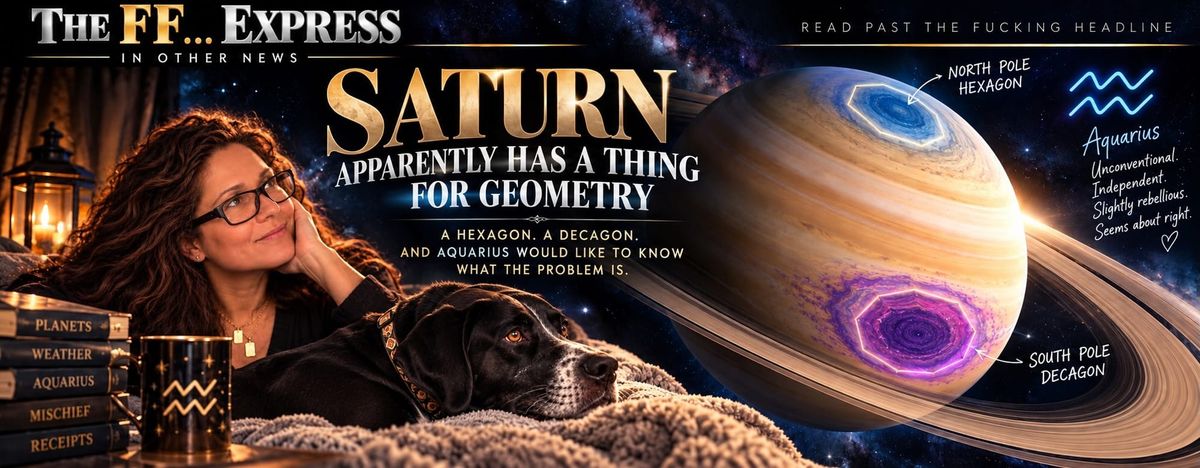
A HEXAGON. A DECAGON. AND AQUARIUS WOULD LIKE TO KNOW WHAT THE PROBLEM IS.
Saturn has been showing off again. For decades, scientists have known that the planet’s north pole is home to one of the strangest weather systems in the solar system: a gigantic six-sided jet stream known, with almost suspiciously little imagination, as Saturn’s Hexagon.
A hexagon - On a planet - Because apparently circles were too predictable. Scientists first spotted the northern hexagon in Voyager data in the early 1980s, and the enormous six-sided wonder has remained remarkably persistent ever since. Which would already be enough weird geometry for one planet — but Saturn disagreed
Yep, that was probably a little too boring for the wonder planet, because apparently Saturn looked at its south pole and thought, “Needs more geometry.” NASA’s Hubble Space Telescope has now revealed a giant 10-sided atmospheric wave — a decagon — encircling Saturn’s south pole. Yes, a fucking decagon. North pole: hexagon. South pole: decagon. Enormous rings around the middle. Somewhere, a geometry teacher just became emotionally invested in Saturn. And before anybody gets carried away, no, NASA did not discover an alien stop sign in space.
The northern hexagon itself is enormous — roughly 30,000 kilometers across — and sits inside one of Saturn’s powerful jet streams. It isn’t a mountain, a crater or some enormous alien Home Depot project. It is atmosphere: a persistent jet-stream pattern whose movement has maintained that remarkably stable six-sided shape around Saturn’s north pole for decades.
Why does Saturn do this? Good fucking question. Researchers think these kinds of shapes can form where atmospheric waves interact with powerful jet streams moving at different speeds. Translation: Saturn has weather, and its weather has opinions. Polygons forming naturally inside a planetary atmosphere sound bizarre until you realize that moving fluids can organize themselves into remarkably regular patterns. Laboratory experiments with rotating fluids have produced polygonal structures too. Under the right conditions, competing currents and waves can settle into shapes that look suspiciously as though somebody arrived with a ruler. Nobody did. Probably.
And no, this is not the kind of thing where you drag a telescope into the backyard, point it at Saturn and yell, “Holy shit, I see the decagon!” Calm down, Galileo. That would be too easy. But when you look up at that little bright point of light, just know that hundreds of millions of miles away there is a planet with a six-sided atmospheric structure on one end and a ten-sided one developing on the other.
AND THEN THE SOUTH POLE ENTERED THE CHAT
Researchers studying Saturn’s atmosphere found traces of the southern decagon in Hubble observations going back to 2023, and watched it become more distinct over subsequent years. The southern structure is not simply a carbon copy of the famous hexagon sitting at the opposite pole. The atmospheric conditions, circulation and behavior are different, and scientists are still working out exactly how the newly observed pattern forms and how persistent it may become.
That is actually the interesting part. Saturn’s northern hexagon has demonstrated remarkable stability for more than four decades, while the southern decagon appears to be newer and evolving. Scientists had been looking for a southern counterpart for years, but Cassini — which orbited Saturn from 2004 until 2017 — never showed evidence of a comparable long-lived polygon at the south pole. Then along came Hubble. Ten sides. Apparently Saturn upgraded.
So Saturn is currently running a fucking geometry curriculum: hexagon upstairs, decagon downstairs, enormous rings around the middle. Show-off.
Saturn is basically an atmospheric laboratory the size of a planet — a researcher’s delight — but scientists cannot exactly stroll over there, stick a Weather Channel microphone into the clouds and ask how everybody is doing. So they watch the movement and study how these shapes can reveal information about wind speeds, atmospheric waves, circulation and the boundaries between different moving layers of gas. Because, let’s face it, this is a rather interesting phenomenon, to say the fucking least. Saturn showing off its two geometrically different poles is not only scientifically interesting from a weather perspective; those differences may also offer another window into how physics governs atmospheres across the solar system.
Which is fascinating. It is also deeply inconvenient for Aquarius.
AQUARIUS HAS REVIEWED THE SITUATION
While somewhere on Earth geometry teachers are buzzing with excitement and trying to push new math, physics and science shit into students’ heads, somewhere else — location undisclosed — an Aquarius looked at the whole situation, shrugged and said, “Saturn doing its own thing? Yeah… seems reasonable.”
And then, naturally, astrology wandered into the science department without an appointment.
Traditional astrology associates Saturn with Aquarius, while modern astrology generally gives Uranus the job. Scientifically, the Saturn-Aquarius drama explains absolutely fucking nothing about Saturn’s atmosphere. But aesthetically? Oh, come on. It feels spectacularly on brand. Aquarius has spent centuries being described as unconventional, independent, slightly rebellious and generally uninterested in doing things the way everybody else does them. Meanwhile, Saturn looked at ordinary circular atmospheric patterns and apparently said, “No. Let’s do polygons.”Of fucking course it did.
Aquarius would therefore like the record to reflect that she was minding her own fucking business — unconventional, independent, slightly rebellious and perfectly comfortable being represented by two squiggly lines while everybody else fights over goats, crabs, twins and whatever Sagittarius is doing with the bow. Then Saturn wandered in carrying a hexagon and a decagon like some celestial overachiever arriving at class with extra-credit homework nobody assigned.
Aquarius has questions. First: Why? Second: Who authorized this? Third: If Saturn produces a dodecagon next, are we expected to pretend this is normal? Aquarius declines. There are limits.
THE UNIVERSE KEEPS DOING THIS SHIT
That may be the best part of stories like this. We have been watching Saturn for centuries. Voyager flew past it. Cassini spent thirteen years orbiting it. Hubble has continued watching it. We have photographed its rings, studied its moons, measured its atmosphere and watched storms move across its clouds — and Saturn still has things to show us.
Not because the laws of physics suddenly stopped working, but because the laws of physics are capable of producing things that look completely fucking ridiculous until we understand how they happen. A six-sided atmospheric structure circling one pole. A newly observed ten-sided wave around the other. No architect. No construction crew. No celestial geometry teacher standing nearby with a protractor. Just gases, winds, waves, rotation and physics doing what physics does when nobody is supervising.
And somewhere on Earth, scientists are studying the data and asking the perfectly reasonable scientific question: What the fuck is Saturn doing now?
Aquarius would also like an answer.
Preferably before Saturn discovers triangles.